Arctic sea-ice melt is rewriting the cloud playbook
August 7, 2026 · By John Ian Lau
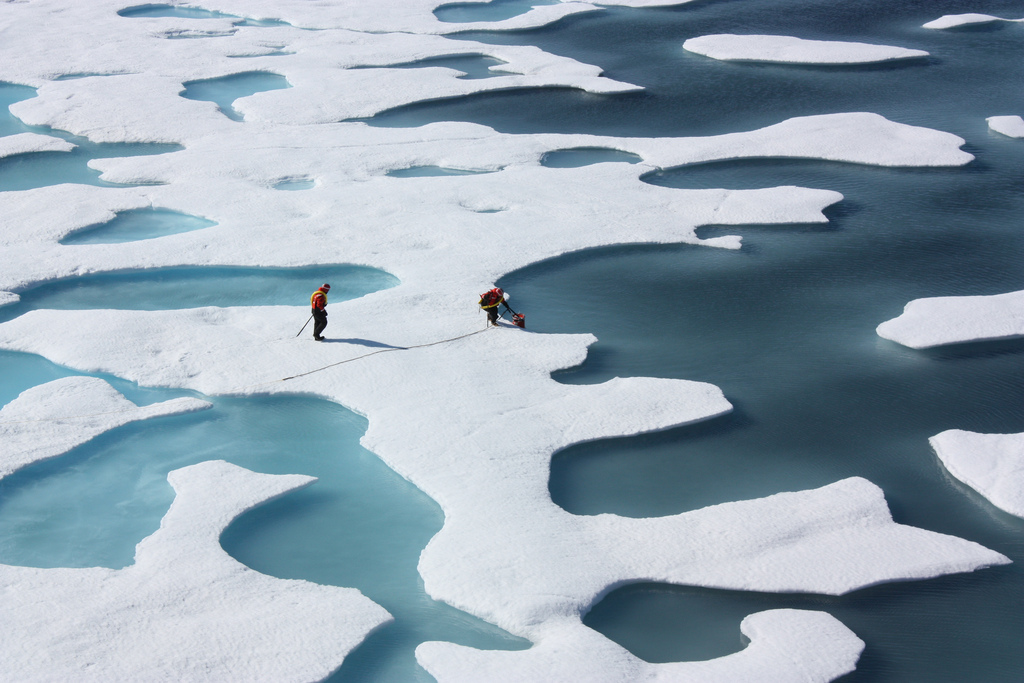
The Arctic’s melting edge is doing more than shrinking a white cover over the ocean. A new field study finds that the boundary between open water and sea ice is also acting as a chemical launchpad for cloud-forming particles — a feedback that current climate models do not yet capture.
Researchers from the University of Birmingham and collaborators reported the finding in Nature Geoscience after measurements made aboard the Royal Research Ship Discovery around Greenland and the Davis Strait in spring and summer 2022. Near the marginal ice zone, where marine algae, sunlight and exposed seawater meet, the number of particles capable of seeding cloud droplets rose from roughly 50 to 1,500 per cubic centimetre during one event, according to the University of Birmingham account.
The mechanism begins with iodine, sulfur and organic compounds released by the productive ice edge. Sunlight transforms those emissions into new particles; the team also identified iodine-containing oxygenated organic molecules, or I-OOMs, that help the particles grow large enough to influence clouds. The process appeared on more than 80% of sunny days in the study region, suggesting it is not an isolated chemical curiosity. Yet it is missing from the climate models used to project how the Arctic will evolve.
That gap matters because clouds are both shield and amplifier. More or thicker clouds in the warming season could reflect sunlight and cool the open ocean, while also potentially accelerating ice melt under some conditions. The research team said the Arctic has warmed more than three times faster than the global average over the past 40 years, making the region unusually sensitive to changes in the atmosphere-ocean system. “These newly identified compounds help small particles grow into larger particles that can seed clouds — we believe this is the first time such molecules have been observed and implies important new pathways for iodine chemistry,” said Dr. James Brean, an assistant professor in atmospheric science at Birmingham, in the university’s release.
The discovery lands in a wider race to observe a system changing faster than its historical baselines. The Intergovernmental Oceanographic Commission of UNESCO describes the Global Ocean Observing System as a network built to deliver physical, chemical and biological information for climate, services and ocean health. Dr. Susan Wijffels, co-chair of the International Argo Science Team, said on the IOC-UNESCO GOOS page: “The IOC has been absolutely essential in enabling us to build a global observing network like Argo. Because we’ve made such incredible progress over the last few years, I think many countries will start to really celebrate Argo and the IOC as one of our best examples of international collaboration.”
The need for that collaboration is underscored by the physics beneath the ice. Scripps Institution of Oceanography research on warm Pacific-origin water entering the Arctic found that subsurface “heat bombs” can persist for months or years and melt sea ice from below. “The rate of accelerating sea ice melt in the Arctic has been hard to predict accurately, in part because of all of the complex local feedbacks between ice, ocean and atmosphere; this work showcases the large role in warming that ocean water plays as part of those feedbacks,” said Jennifer MacKinnon, a Scripps physical oceanographer and lead author, in Scripps’ account.
For governments, ports and communities that depend on Arctic forecasts, the implication is operational: observing the ocean surface alone is not enough. Satellites can map ice, ships can sample chemistry, and autonomous profilers can follow heat and salt below it, but the value comes when those streams are joined and shared. NASA’s Arctic sea-ice record, built from satellite microwave observations jointly operated by NASA and NOAA, shows how long-running public data can turn an invisible shift into a management signal.
OceanVines sees that work as both science and service: to illuminate the inner sparks of every life we touch through our efforts in ocean conservation and education. The Arctic’s new cloud chemistry is a reminder that the ocean is not a backdrop to climate change. It is an active, connected engine — and better observation is the first form of stewardship. Together, we celebrate The Greatest Good
Hashtags: #TheGreatestGood #OceanConservation #HumanityMatters #LIT #ArcticScience #ClimateObservation